Showing posts with label assessment. Show all posts

Thursday, October 13, 2016

Resources for Indiana Transition Teachers

Hoosier middle and high school teachers now have access to hundreds of transition assessments, tutorials, checklists, presentations, and Transition IEP guides with the introduction of the updated and redesigned Indiana Secondary Transition Resource Center (INSTRC) website.

INSTRC, a project of the Indiana Institute’s Center on Community Living and Careers, is funded by the Indiana Department of Education to assist transition educators and administrators as they comply with federal transition requirements and provide their students and their families with the information and experiences they need to move from high school to their postsecondary lives. There you will discover:

  • Resource Collections: Including health, sample IEPs, information for new teachers and families, and more.
  • Transition Assessment Matrix: Assessments are a key component of transition planning. The new Matrix allows teachers to quickly find age-appropriate transition assessments that fit their student.
  • Access to dozens of state and national education, employment, and service organizations.

To access this site, please visit:
https://instrc.indiana.edu/

Wednesday, July 6, 2016

ADHD rating scale-5 for children and adolescents: Checklists, norms, and clinical interpretation


ADHD rating scale-5 for children and adolescents: Checklists, norms, and clinical interpretation is a 124-page guide for mental, educational, and medical practitioners to screen, diagnose, and evaluate treatment for attention deficit hyperactivity disorder. Meant to determine the frequency and severity of ADHD symptoms in children ages 5-17, this assessment includes complete instructions for scoring and interpretation for both boys and girls separately.

The test offers parent questionnaires in both English and Spanish and cover behavior seen at home and teacher questionnaires cover classroom behavior. It is keyed to the DSM-5 diagnostic criteria for ADHD to offer the most up-to-date results, and photocopy permission is included for continual use without having to purchase additional forms. This new edition includes functional impairment items linked to each symptom dimension (inattention symptoms and hyperactive-impulsive symptoms) and full analysis of the revised scale's psychometric properties.

Want to check it out? Email us at cedir@indiana.edu or use worldcat.org to find it in a library near you.

Friday, May 15, 2015

Developmental Profile 3


Like previous versions, this fully revised third edition of the Developmental Profile evaluates children’s functioning in five key areas, in just 20 to 40 minutes. However, this edition adds norm-based standard scores, an expanded age range, updated item content, clearer interpretive guidelines, a nationally representative standardization sample, new empirical studies demonstrating its reliability and validity, and unlimited computer scoring and interpretation.

Want to check it out? Email us at cedir@indiana.edu or use worldcat.org to find it in a library near you.

Friday, February 20, 2015

Testing accommodations for students with disabilities: Research-based practice


Testing accommodations for students with disabilities: Research-based practice offers research-based guidelines for deciding when test accommodations are appropriate for a student with disabilities. The authors take into account the test being taken, the accommodations being considered, and the student's functional skills. Case studies apply the guidelines to specific scenarios.

Interested? Email us at cedir@indiana.edu to check out this title or use worldcat.org to find it in a library near you.

Friday, January 16, 2015

Functional behavior assessment for people with autism: Making sense of seemingly senseless behavior


This second edition of Functional behavior assessment for people with autism has been updated with new research, case studies, and anecdotes, the authors explain how clinicians conduct FBAs: measuring behavior; observing behavior and collecting data; testing the hypothesis about the behavior's function. And now, there's new material about how to do FBAs outside of clinical settings--at school, in the community, and at home--making this strategy more accessible to parents and teachers in daily life. -from the book description

Want to check it out? Email us at cedir@indiana.edu or use worldcat.org to find it in a library near you.

Monday, November 24, 2014

Mobile App Monday - StepByStep


StepByStep, created by an Occupational Therapist, helps assess and improve sequencing skills for kids and adults of all cognitive levels. Simply drag each step and arrange a sequence into the correct order. StepByStep uses fun and clearly-illustrated sequences of Activities of Daily Living (ADLs), Instrumental Activities of Daily Living (IADLs), and Transfers. Recommended for Occupational Therapists, Speech Language Pathologists, parents, and teachers. -iTunes

Want to learn more about it? Please visit:

Thursday, September 4, 2014

Curriculum-Based Assessment for Instructional Design: Using Data to Individualize Instruction


Accessibly written and featuring illustrative case examples, Curriculum-Based Assessment for Instructional Design provides a complete guide to curriculum-based assessment for instructional design (CBA-ID). CBA-ID comprises easy-to-implement, reliable, and valid procedures for determining a student's instructional level and individualizing instruction by developing tasks that are neither too hard nor too easy. It is a key tool for supporting K-8 students who are struggling in reading, math, or writing, and is ideally suited for intervention planning within multi-tiered systems of support. -from the book description

Interested? Email us at cedir@indiana.edu to check out this title or use worldcat.org to find it in a library near you.

Friday, July 25, 2014

Reading-free vocational interest inventory 2


Want to gauge the vocational interests of teens or adult with disabilities? The R-FVII:2 measures the vocational interests of special populations by offering pictures of individuals engaged in different occupations to measure the vocational likes and dislikes of students and adults who have intellectual disabilities, learning disabilities, adult with other disadvantages, or those enrolled in alternative or vocational/career training programs. It is appropriate for use by teachers, psychologists, counselors, or other vocational and educational personnel in junior high, senior high, vocational/technical schools, sheltered work centers, and other job training and work placement career centers.
Ages: 13 years through Adult Testing Time: 20 minutes

Want to check it out? Email us at cedir@indiana.edu or use worldcat.org to find it in a library near you.

Thursday, July 17, 2014

Assessment and student success in a differentiated classroom


Assessment and Student Success in a Differentiated Classroom outlines a common-sense approach that is both thoughtful and practical, and that empowers teachers and students to discover, strive for, and achieve their true potential. Grounded in research and the authors' teaching experience, Tomlinson and Moon take an in-depth look at assessment and show how differentiation can improve the process in all grade levels and subject areas.

Interested? Email us at cedir@indiana.edu or use worldcat.org to find it in a library near you.

Friday, March 28, 2014

Parenting Interactions with Children: Checklist of Observations Linked to Outcomes


Working with parents to support young children's cognitive, social, and language development? Try using PICCOLO™, the quick, reliable observational tool designed to assess and monitor the quality of parent–child interactions. Developed for use with parents of children ages 1 to 3, PICCOLO measures 29 developmentally supportive parenting behaviors in 4 critical domains—Affection, Responsiveness, Encouragement, and Teaching.

Want to learn more about it? Email us at cedir@indiana.edu to check out this title or use worldcat.org to find it in a library near you.

Friday, June 7, 2013

Demystifying Transition Assessment


Need help with assessing transition plans? Demystifying transition assessment might be what you're looking for. Refer to this practical guide to use today's best assessment tools and strategies when identifying which transition approaches really work. You'll discover how to:

  • choose assessments appropriate for each situation and student
  • apply best assessment practices in 7 key areas (see sidebar)
  • collect the right data at the right time
  • implement evidence-based practices that meet IDEA requirements for transition assessment
  • and more!

Interested? Email us at cedir@indiana.edu to check it out or use worldcat.org to find it in a library near you.

Wednesday, January 30, 2013

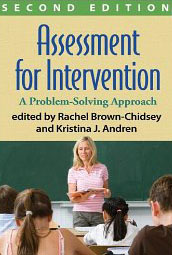
Assessment for Intervention


Looking for current education policy and best practices when it comes to assessing students' need for intervention? Assessment for Intervention: A Problem-Solving Approach can help. This book provides a complete guide to implementing a wide range of problem-solving assessment methods: functional behavioral assessment, interviews, classroom observations, curriculum-based measurement, rating scales, and cognitive instruments.

Want to know more? Check it out by emailing us at cedir@indiana.edu or by using worldcat.org to find it in a library near you.

Thursday, January 10, 2013

Reading assessment in an RTI framework


Book Description for Reading Assessment in an RTI Framework:
"From leading experts, this indispensable resource presents a practical model for conducting reading assessments for screening, diagnosis, and progress monitoring in each of the three tiers of response to intervention (RTI). K-8 teachers and school personnel are guided to use norm-referenced, informal, and curriculum-based measures to assess key components of reading development and make informed choices about instruction. The book describes how to survey existing assessment practices in a school and craft a systematic plan for improvement; reproducible tools include a 10-page RTI Assessment Audit that can be downloaded and printed in a convenient 8 1/2" x 11" size.

"See also Assessment for Reading Instruction, Second Edition, which explains the fundamentals of assessment and provides essential hands-on tools."

To check out this title, email us at cedir@indiana.edu or use worldcat.org to find it in a library near you.

Friday, March 23, 2012

Systematic Screenings of Behavior to Support Instruction


Book Description for Systematic Screenings of Behavior to Support Instruction:

"Straightforward, practical, and user friendly, this unique guide addresses an essential component of decision making in schools. The authors show how systematic screenings of behavior—used in conjunction with academic data—can enhance teachers' ability to teach and support all students within a response-to-intervention framework. Chapters review reliable, valid screening measures for all grade levels, discuss their strengths and weaknesses, and explain how to administer, score, and interpret them. Practitioners get helpful guidance for evaluating their school's needs and resources and making sound choices about which tools to adopt."

Interested? Email us at cedir@indiana.edu to check out this title or use worldcat.org to find it in a library near you.

Tuesday, January 31, 2012

Embedded formative assessment


Embedded formative assessment looks at our increasingly complex world of the 21st century and demands that we must concentrate on increasing educational achievement by increasing the quality of the teachers in our schools. Author Dylan Wiliam makes a case for the important role of formative assessment in increasing teacher quality and student learning. While there are many possible ways to develop the practice of serving teachers, attention to minute-by-minute and day-to-day formative assessment is likely to have the biggest impact on student outcomes. Wiliam's view of formative assessment differs from the popular view in that he regards formative assessment as a process rather than a tool.

Interested? Check out this title by emailing us at cedir@indiana.edu, or use worldcat.org to find it in a library near you.

Thursday, November 3, 2011

Alternative Approaches to Assessing Young Children


Looking for a little help assessing young children who are developmentally diverse? Alternative approaches to assessing young children might be the answer. Now in its second edition, this book was written by experts in early childhood special education. Thoroughly updated to include the last 10 years demographics, research, technology, and legislation, this book is also easy to use. Chapter review questions, a glossary, in-depth case studies, and a sample syllabus help make this text accessible for college instructors.

Want to check it out? Email us at cedir@indiana.edu. Or use worldcat.org to find it in a library near you.

Wednesday, September 28, 2011

The Formative Assessment Action Plan


The formative assessment action plan: Practical steps to more successful teaching and learning offers real-life scenarios showing you how to implement the four steps in formative assessment in your classroom. These four steps:

  • Where am I going?
  • Where am I now?
  • How am I doing?
  • Where am I going next?

help you get the most out of your assessment data in order to adjust your classroom or individual instruction in a more beneficial way.

To check out this title, email us at cedir@indiana.edu. Or use worldcat.org to find it in a library near you.

Thursday, September 15, 2011

The Formative Assessment Action Plan


From the product description:

"Join Nancy Frey and Douglas Fisher as they outline a clear-cut, realistic, and rewarding approach to formative assessment. They explain how four discrete steps work in tandem to create a seamless, comprehensive formative assessment system one that has no beginning and no end. This ongoing approach enhances an active give-and-take relationship between teachers and students to promote learning...

No matter what grade level you teach, The Formative Assessment Action Plan will help you make better use of assessment data so you can more quickly adjust instruction to keep every student on the path to success."

Check out this title by emailing us at cedir@indiana.edu. Or try worldcat.org to find it in a library near you.

Wednesday, August 24, 2011

Using Formative Assessment to Differentiate Mathematics Instruction


Looking for help with formative assessment in teaching Math? Pick up Using formative assessment to differentiate mathematics instruction, grades 4-10: Seven practices to maximize learning. Reviewers laud this book as, "practical and thought-provoking," "a wealth of information," and "powerful." With ready-to-teach tiered lesson examples and resources galore, this book will have you ready to use formative assessment in no time.

To check out this title, email us at cedir@indiana.edu, or try worldcat.org to find it in a library near you.

Tuesday, August 2, 2011

Essentials of Specific Learning Disability Identification


Looking for an overview of the definitions and methods for identifying specific learning disabilities (SLDs)? Essentials of Specific Learning Disability Identification focuses on describing the manifestations of SLDs in the areas of reading, writing, math, oral expression, and listening comprehension. It features contributions by leading experts in the field, including Virginia Berninger, Steven Feifer, Jack Fletcher, Nancy Mather, Jack Naglieri, and more.

Interested? Email us at cedir@indiana.edu to check it out. Or try worldcat.org to find it in a library near you.